

Project Background
The transportation of liquid energy products, including refined oil and chemical materials, requires strict security management throughout the entire delivery process.
Oil tankers typically contain multiple compartments, bottom discharge valves, and top manhole covers. Traditional mechanical seals provide basic protection but cannot offer real-time monitoring, remote alerts, or digital records when unauthorized operations occur during transportation.
For energy fleet operators, deploying independent GPS tracking devices on every valve is often costly and inefficient due to additional hardware requirements and cellular communication expenses.
Meanwhile, fuel transportation environments require special consideration. As vehicles frequently operate in fuel depots, terminals, and other hazardous areas, monitoring devices need to support safe installation methods and reliable operation under demanding conditions.
To address these challenges, an energy fleet implemented HBOIOT’s HB-A1Ms Wireless Slave Lock System to improve multi-valve security management and strengthen digital monitoring throughout oil transportation operations.
Solution: HB-A1Ms Wireless Slave Lock System
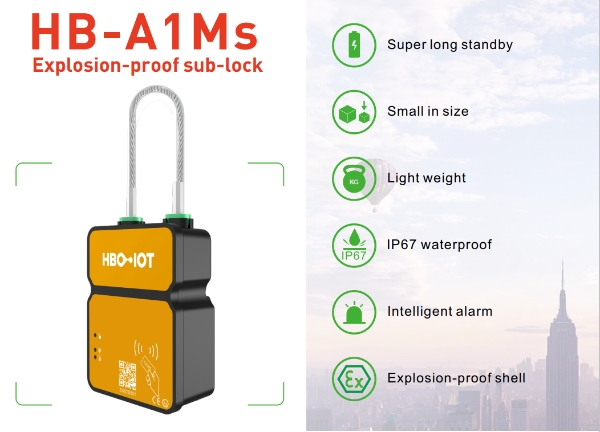
The HB-A1Ms adopts a master-slave wireless architecture designed specifically for multi-valve protection scenarios.
Instead of installing independent GPS tracking devices on every valve, multiple HB-A1Ms wireless slave locks can connect with a GPS master lock installed on the vehicle.
Through this architecture, the system enables centralized communication, location tracking, and security monitoring while reducing deployment complexity.
Core Application Scenarios
1. Wireless Multi-Valve Protection for Oil Tankers
Oil tankers often require monitoring of multiple access points, including:
Bottom API discharge valves
Top manhole covers
Multiple cargo compartments
After loading is completed at refineries or fuel depots, HB-A1Ms wireless slave locks are installed on these critical access points.
The slave locks communicate with a GPS master lock (such as HB-A1Lm) through short-range wireless networking. The master device is responsible for centralized communication and data transmission to the management platform.
This “one master, multiple slaves” architecture helps simplify fleet deployment while enabling centralized monitoring of multiple locking points.
2. Wire-Free Deployment for Hazardous Transportation Environments
Fuel transportation requires reliable security equipment while avoiding installation methods that may introduce additional risks.
The HB-A1Ms features a self-powered wireless design, eliminating the need for complex wiring installation on tanker vehicles.
With durable industrial construction and IP67 protection, the device is designed to operate reliably in challenging environments.
3. Controlled Electronic Unlocking at Delivery Locations
During multi-stop fuel distribution, unauthorized unloading outside approved locations can create significant security risks.
The HB-A1Ms system supports geo-fencing-based management. Unlocking permissions can be activated only when the vehicle reaches an authorized area.
Authorized operators can unlock specific slave locks through:
RFID authentication
Bluetooth (BLE) connection
Remote commands from the management platform
This helps energy fleet operators improve unloading control and maintain digital records of transportation activities.
Energy Transit Pain Points Resolved
1. Reducing Installation Complexity and Equipment Costs
Traditional wired locking solutions can require complex installation processes on tanker vehicles, especially when multiple valves need protection.
The HB-A1Ms wireless slave lock system reduces installation complexity through wireless communication between slave locks and the GPS master device.
By using a centralized master-slave structure, fleet operators can simplify device deployment and reduce the need for multiple independent communication modules.
2. Improving Detection of Unauthorized Fuel Access
Traditional mechanical seals cannot provide electronic records when unauthorized opening or tampering occurs.
The HB-A1Ms integrates security monitoring functions, including:
Unauthorized unlocking detection
Lock wire cutting detection
Tamper event recording
When abnormal events occur, the system can send alerts through the GPS master lock to the cloud platform.
Project Outcomes
Improved Multi-Valve Security Management: The HB-A1Ms wireless slave lock system helped the energy fleet strengthen protection of multiple tanker access points and improve control over fuel transportation processes.
Reduced Deployment Complexity: Through the master-slave wireless architecture, multiple locks can be managed through a centralized GPS master device, simplifying installation and fleet management.
Enhanced Transportation Visibility and Compliance: By combining electronic locking, GPS tracking, and digital records, the solution provided better visibility into tanker operations and supported more efficient transportation supervision.
More Efficient Loading and Unloading Operations: Wireless installation and electronic verification helped reduce manual inspection procedures and improve efficiency during vehicle dispatch and delivery processes.